













This guide is for buyers sourcing stainless steel wire homeware for resale, private label, or a custom project. Begin with a written product specification, compare quotes on that same specification, approve a sample, and confirm the packed cargo data before booking freight.
Importing stainless steel homeware from China starts with finding a supplier that can make the product you need at a cost that works after freight, customs, and delivery. This guide follows a typical order for wire dish racks, sink caddies, shower caddies, and storage baskets, from supplier research to the first warehouse receipt.
TANAPBAEKGA supplies these products, and this guide explains procurement from that supplier perspective. Manufacturing and inspection notes draw on our published project workflow. Trade terms, customs references, market addresses, and transit examples link to their sources beside the relevant information.
Step 1. Where to Find Stainless Steel Homeware Suppliers in China
Search online by product, process, and location
Start with a specific product name and add words such as manufacturer, OEM, or a city. Searching for a “304 stainless steel wire dish rack manufacturer” gives you a more useful starting point than searching for “stainless steel products.” Try local-language searches as well. The Chinese phrases below are ready to copy.
| Where to search | Sample search terms |
|---|---|
| Alibaba.com | OEM dish rack stainless steel, stainless steel cup organizer manufacturer, custom stainless steel wire basket China |
| 1688 | 不锈钢沥水架厂家 (dish rack factory), 304不锈钢浴室置物架批发 (304 stainless steel shower caddy wholesale), 定制不锈钢篮子 (custom wire baskets) |
| Douyin (China) and Xiaohongshu (RedNote) | 潮州不锈钢日用品工厂 (Chaozhou stainless steel homeware factory), 不锈钢篮子制造商 (Stainless Steel Basket Manufacturer), 不锈钢线材加工 (Stainless Steel Wire Processing) |
| Instagram and TikTok | stainless steel wire basket factory China, dish rack factory tour, stainless steel homeware manufacturer |
| Google Search | stainless steel homeware manufacturer Chaozhou, white label stainless steel dish rack supplier China, custom wire forming and welding China |
Use social media videos and marketplace listings to build a shortlist. To help distinguish between a trading company and an actual manufacturer, arrange a live video call through the supplier’s official business account. Ask the sales representative to use their mobile phone to give you a real-time walkthrough of the factory, including the production workshops, machinery, equipment, and manufacturing processes. This can help you verify whether the supplier operates its own production facilities.
Then ask for the supplier’s legal company name, production address, samples of similar work, and the name of the company that will sign the order and receive payment. On 1688, ask whether the seller can arrange export documentation and international shipping, or whether you will need a separate agent.
Visit trade fairs, wholesale markets, and manufacturing clusters
| Trade fair | Venue and address | Sourcing advantages |
|---|---|---|
| China Import and Export Fair (Canton Fair) – Phase 2 | China Import and Export Fair Complex, No. 382 Yuejiang Zhong Road, Haizhu District, Guangzhou, Guangdong, China. | Useful for comparing a broad range of kitchenware, tableware, and household products in one visit. Meet suppliers serving overseas markets, compare product ranges, and discuss export packaging and private-label requirements. Confirm the relevant product section and hall for the edition you plan to attend. |
| Guangdong Chao’an Stainless Steel Industry Conference & Chaoshan Stainless Steel Industrial Base Exhibition | Dongshanhu Expo Center (Chao’an Pillar Industry Incubation Base), middle section of Zhongxing Avenue, Dongshanhu, Chao’an District, Chaozhou, Guangdong, China. | Small-MOQ manufacturing discussions, nearby factory visits, and direct-from-factory pricing opportunities. Held within the local stainless steel manufacturing cluster, the fair makes it convenient to meet exhibitors and arrange visits to nearby workshops during the same trip. Ask about small trial orders and customized production; available MOQ depends on the design, material, tooling, finish, and packaging. Buying directly from local manufacturers can reduce intermediary costs and provide competitive factory quotations. |
| China Daily-Use Articles Trade Fair (CDATF) | Shanghai New International Expo Center (SNIEC), No. 2345 Longyang Road, Pudong New Area, Shanghai, China. | A focused option for everyday homeware sourcing, including kitchenware, household storage, and related daily-use products. Compare new designs and complementary product lines, meet manufacturers for OEM/ODM discussions, and build assortments for wholesale, retail, or e-commerce channels. |
| China (Shenzhen) International Gifts, Handicrafts, Watches & Houseware Fair | Shenzhen World Exhibition & Convention Center, No. 1 Zhancheng Road, Fuhai Subdistrict, Bao’an District, Shenzhen, Guangdong, China. | Useful for design-led houseware, branded gifts, and retail-ready product presentation. Compare kitchen and household products alongside gift packaging and customization options, and discuss logo application, gift sets, and packaging with suitable suppliers. |
| Market or production area | Where to go | Why visit |
|---|---|---|
| Chaozhou & Jieyang Stainless Steel Manufacturing Cluster | Chaozhou: Caitang Town, Chao’an District, Chaozhou, Guangdong, China. Jieyang: Meiyun Subdistrict, Rongcheng District, Jieyang, Guangdong, China. | A well-established stainless steel manufacturing base with a strong supply chain for kitchenware, household products, and metal hardware. Ideal for sourcing manufacturers, comparing production capabilities, and developing customized wire products, kitchen organizers, and stainless steel homeware. |
| Yiwu International Trade City, District 2 | Yiwu International Trade City, District 2, Chouzhou North Road, Yiwu, Jinhua, Zhejiang, China. | One of China’s major wholesale sourcing markets, offering a wide selection of kitchenware, bathroom hardware, household accessories, and general merchandise. Ideal for comparing product designs, prices, packaging options, and suppliers, as well as sourcing ready-made products for wholesale and distribution. |
| Guangzhou Xinji Shaxi Hospitality Supplies Market | Xinji Shaxi Hospitality Supplies Expo Center, No. 11 Shaxi Avenue, Luopu Subdistrict, Panyu District, Guangzhou, Guangdong, China. | A specialized wholesale market for hotel, restaurant, and catering supplies, featuring stainless steel products, kitchenware, tableware, and hospitality equipment. Ideal for finding commercial-grade products, comparing suppliers, and sourcing a wide range of finished goods for hospitality and catering businesses. |
| Jiangmen Xinhui Wire Houseware Manufacturing Cluster | Xinghuang Industrial Development Zone, Siqian Town, Xinhui District, Jiangmen, Guangdong, China. | An established stainless steel manufacturing base with a concentration of hardware and stainless steel product manufacturers. Suitable for sourcing kitchenware, household metal products, and OEM suppliers, while comparing manufacturing capabilities, product quality, and export experience. |
A trade fair or wholesale market helps you see products and meet sellers in one trip. For custom work, follow up with a factory visit or a live walkthrough of the relevant production line. Ask which work the supplier performs in-house and which work it outsources.
Step 2. Contact Your Supplier and Request a Quotation
What to send with your first inquiry
If you have import experience: Send your product list with model numbers, quantities by SKU, material and finish, drawings or sample references, packaging instructions, destination, and preferred trade term. Identify any specification that affects fit or function, such as wire diameter, sheet thickness, or mounting hole spacing.
If this is your first import: Explain your sales channel, target customer, and what you want the product to do. A reference photo and approximate dimensions are enough to start. Tell the manufacturer your expected quantity, material preferences, destination, and packaging needs. Ask it to suggest specifications where you are unsure. Include outer carton shipping marks and any e-commerce labels you need, such as a product barcode, an FNSKU where applicable, or a fulfillment-center carton label. Share approved artwork and placement instructions before packing.
For stainless steel wire homeware, contact TANAPBAEKGA by email at support@tanapbaekga.com, by phone at +86 136 7141 1384, or through our website inquiry form.
Define the details that change the quote
For a wire rack, record overall dimensions and the usable inside opening separately. Specify the wire diameter for the frame and the supporting wires if they differ. Mark mounting centers, tray clearances, and the parts that must fit together on the drawing. Attach a finish reference and identify the packaging included in the unit price.
TANAPBAEKGA works with 201 and 304 stainless steel, as well as carbon steel. Specify the material grade and applicable standard in the order, together with any material documentation or testing you require. Have the factory confirm feasibility before treating a suggested material, wire diameter, or finish as approved. See our materials and customization FAQ.
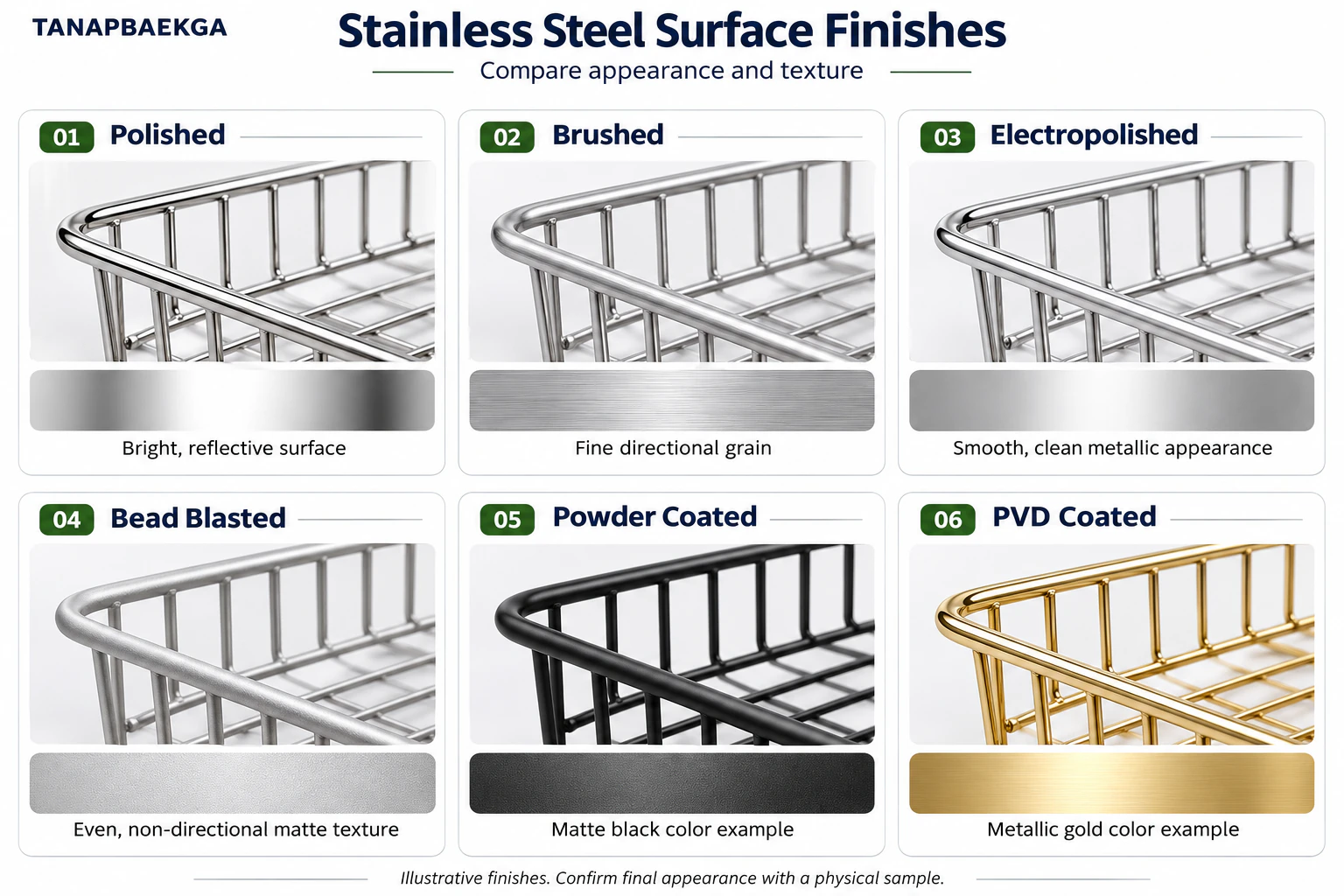
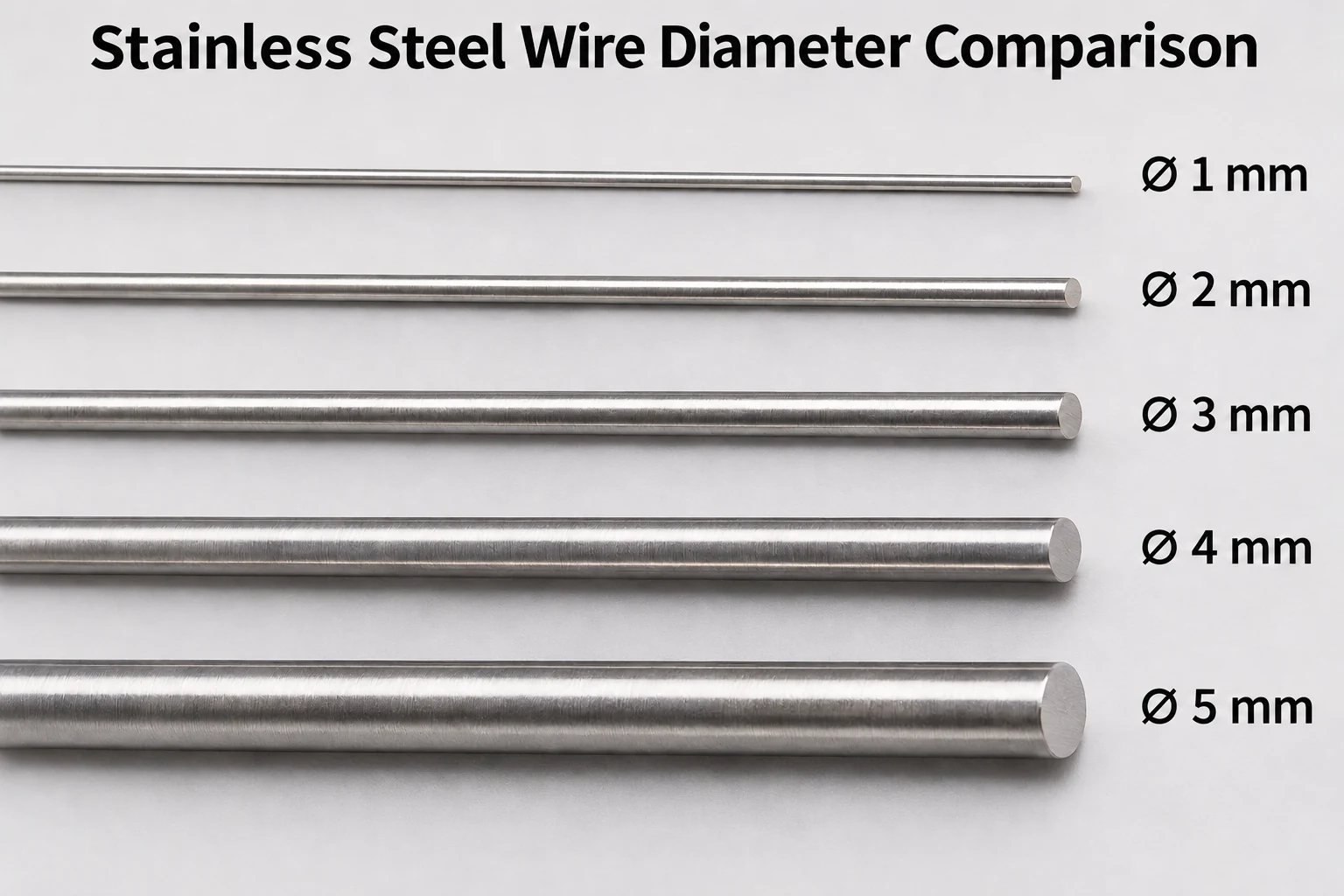
For custom products, we usually select a suitable stainless steel wire diameter based on the product’s design and intended use. If you have specific requirements or exact wire diameter specifications, share them with the manufacturer. Once the specifications are agreed, the manufacturer will source the selected stainless steel wire and use it to manufacture your products.
Confirm the EXW Unit Price, Packed Volume (CBM), and Weight with Your Supplier
The EXW unit price is the supplier’s factory-gate selling price for the agreed product and packaging. Confirm the following three inputs before comparing quotations or choosing a shipping plan.
| Quotation input | What to confirm with the supplier | How you will use it |
|---|---|---|
| EXW unit price (per pc) | The price per piece, currency, quantity by SKU, included packaging, and named factory or pickup place. List tooling, samples, testing and other extras separately. | Use the single-piece EXW price as the starting point to calculate and audit FOB, CIF, DDP or other trade-term quotations. Add only costs outside that price. |
| Packed volume (CBM) | Outer carton length, width and height; pieces per carton; total carton count; and total packed CBM. Include pallet dimensions and count if used. | Compare LCL (shared-container) and FCL (full-container) shipping prices and loading plans. Use packed dimensions to estimate the space the order will occupy. |
| Net and gross weight | Net weight per product, gross packed weight per carton, and total shipment gross weight. Recheck estimates after packing. | Use gross weight together with packed dimensions to compare sea-LCL and air-freight charges. Ask the forwarder to confirm the weight-or-volume basis and chargeable weight. |
Weight and volume work together. Volumetric weight is calculated from package dimensions; gross weight is the weight of the packed goods. Air freight commonly compares actual gross weight with volumetric weight, while sea LCL commonly uses a weight-or-measure basis. Confirm the forwarder’s conversion factor, minimum charges and quotation basis.
How Costs Are Allocated under EXW, FOB, CIF, DAP, and DDP
Use the breakdown below to check which costs are included in a supplier’s quotation and which remain in your budget. The EXW product price is the baseline; confirm each additional charge against the named place or port and the agreed service scope.
| Trade term | Factory / supplier price components | Buyer’s additional costs |
|---|---|---|
| EXW — named factory or pickup place | EXW product price: manufacture and agreed packaging, with the goods made available at the named place. | Pickup loading + origin inland transport + export clearance + origin port / terminal charges + international freight + destination charges + import clearance, duties and taxes + destination-country delivery. Add cargo insurance if arranged. |
| FOB — named origin port | EXW product price + origin loading and inland transport + export clearance + origin port charges through loading on board the vessel. | International freight + cargo insurance if arranged + destination charges outside the freight contract + import clearance, duties and taxes + destination-country delivery. |
| CIF — named destination port | FOB cost components + ocean freight to the named destination port + the cargo insurance required under CIF. | Destination charges outside the freight contract + import clearance, duties and taxes + onward delivery. Add any extra insurance cover agreed separately. |
| DAP — named destination place | EXW product price + origin loading, inland transport, export clearance and port charges + international freight + destination handling and transport to the named place, ready for unloading. Include insurance if separately agreed. | Import clearance + applicable import duties and taxes + unloading at the named place, unless already covered by the seller’s carriage contract. |
| DDP — named destination place | EXW product price + origin loading, inland transport, export clearance and port charges + international freight + import clearance, applicable duties and taxes + destination handling and transport to the named place, ready for unloading. Include insurance if separately agreed. | Unloading at the named place, unless already covered by the seller’s carriage contract, plus any services outside the agreed delivery scope. |
Insurance, unloading and delivery scope. Of these five terms, CIF requires the seller to obtain cargo insurance, normally minimum cover. EXW, FOB, DAP and DDP do not require either party to buy insurance for the other; agree separately on any cover and its cost. Destination handling and unloading charges depend on the carriage contract and the delivery point. FOB and CIF apply to sea and inland waterway transport. See the ICC Incoterms® 2020 selection guide.
Write the trade term, exact named place or port, and Incoterms® 2020 in the order. Ask the supplier and forwarder to itemize the same scope so costs are not omitted or counted twice. Step 3 explains transport choices and risk transfer; Step 4 covers duty and import-tax estimates.
Step 3. Find a Freight Forwarder and Compare Shipping Costs
Choose a shipping method based on your destination, packed cargo volume, gross weight and required delivery date. For stainless steel homeware, compare the packed shipment rather than product dimensions alone: bulky racks and baskets can use substantial space even when their weight is modest.
Choose a transport method for your shipment
Road and rail are options on selected overland routes from China. For overseas shipments, sea freight is often economical for larger volumes, while air freight and express courier suit urgent replenishment and samples. Confirm service availability and compare complete delivery quotations for your route.
| Transport method | Best fit and key considerations | Example destinations from China | Relative cost guide |
|---|---|---|---|
| Cross-border road freight (truck) | Regional orders needing flexible pickup and final delivery. Border procedures and transfers depend on the route. | China → Vietnam, Laos, Thailand, Malaysia and Singapore. | Route-dependent; compare with rail and sea. |
| Rail freight | Regular replenishment where an available rail service offers a suitable balance of cost and delivery time. | China → Kazakhstan, Germany, Poland and Laos. | Often between sea and air; confirm the full route. |
| Sea freight – LCL (less than container load) | Trial orders or replenishment shipments that share container space with other shippers. Compare with FCL as cargo volume grows. | China → South Korea, Japan, the United States, the United Kingdom, Germany, the Netherlands, Australia, the United Arab Emirates, Vietnam and Thailand. | Check minimum charges and origin/destination fees. |
| Sea freight – FCL (20GP) | Denser or heavier cargo suited to a smaller full container. Indicative internal capacity: approximately 33 CBM. | China → South Korea, Japan, the United States, the United Kingdom, Germany, the Netherlands, Australia, the United Arab Emirates, Vietnam and Thailand. | Can offer a low unit cost with a suitable loading plan. |
| Sea freight – FCL (40HQ) | Bulky household products, racks and organizers needing more space. Indicative internal capacity: approximately 76 CBM. | China → South Korea, Japan, the United States, the United Kingdom, Germany, the Netherlands, Australia, the United Arab Emirates, Vietnam and Thailand. | Compare the total container cost and units loaded. |
| Air freight and express courier | Urgent replenishment, samples and smaller shipments. Express courier can include delivery to the buyer’s address. | China → South Korea, Japan, the United States, the United Kingdom, Germany, Australia, the United Arab Emirates and Singapore. | Generally higher; check actual and volumetric weight. |
Container capacity and payload. The figures above are approximate internal volumes. For reference, Hapag-Lloyd lists 33.2 CBM for a 20-foot standard container and 76.3 CBM for a 40-foot high-cube container. Actual usable space depends on carton dimensions, pallets and loading arrangements. Permitted cargo weight also depends on the equipment, carrier, route and inland transport limits; have your forwarder confirm the loading plan and weight allowance before booking.
Find a freight forwarder for your route
Look for a forwarder that regularly serves your destination and handles your shipment size and preferred transport method. Try Douyin and RedNote for Chinese-language searches, and Instagram, TikTok or Google Search for English queries. Replace the example destination with your actual country, city or port.
| Service | English searches | Chinese searches |
|---|---|---|
| Cross-border road freight | China to Vietnam cross-border trucking, China to Thailand door-to-door road freight | 中国到越南跨境陆运, 中国到泰国陆运到门 |
| Rail freight | China to Poland rail freight forwarder, China to Kazakhstan rail shipping | 中国到波兰铁路货代, 中国到哈萨克斯坦铁路运输 |
| Cross-border parcel or courier | China cross-border parcel shipping to South Korea, China sample courier to USA | 中国到韩国跨境小包, 中国到美国国际快递样品 |
| LCL ocean freight (shared container) | Shenzhen to Busan LCL sea freight forwarder, China to Rotterdam LCL door to door | 深圳到釜山海运拼箱货代, 中国到荷兰海运拼箱到门 |
| FCL ocean freight (dedicated container) | China to Los Angeles FCL 40HQ freight quote, Nansha to Sydney full container shipping | 中国到洛杉矶整柜运输 40HQ, 南沙到悉尼海运整柜货代 |
| Air freight | Guangzhou air freight forwarder to Seoul | 广州到首尔空运货代 |
How to compare shipping costs
Compare written quotations for the same cargo and delivery scope. A suitably loaded FCL shipment can reduce cost per unit; LCL suits smaller orders but may carry minimum and destination handling charges. Road and rail can be competitive on suitable routes, while air freight and express courier generally cost more.
Give every forwarder the same goods description, pickup location, delivery address or port, cargo-ready date, carton count, outer carton dimensions, total CBM, gross weight and stackability information. Ask for a written breakdown covering pickup, export handling, main freight, destination charges, customs brokerage, duties and taxes where included, and final delivery. State the same trade term and named place or port for every quotation.
Confirm the charging basis, minimum charges, quotation currency and validity, estimated door-to-door lead time, and storage or delay charges. For air freight and courier, ask how actual and volumetric weight determine the chargeable weight; lightweight but bulky samples can still be expensive to ship.
If you already work with a freight forwarder, send your supplier the forwarder’s contact details. Your supplier can then coordinate with the forwarder and use the rates provided to calculate the shipping costs in your quotation. If this is your first time importing, TANAPBAEKGA can recommend a reliable freight company for your destination. We can also help calculate shipping costs and optimize carton packing and container loading plans to make better use of space and manage freight expenses.
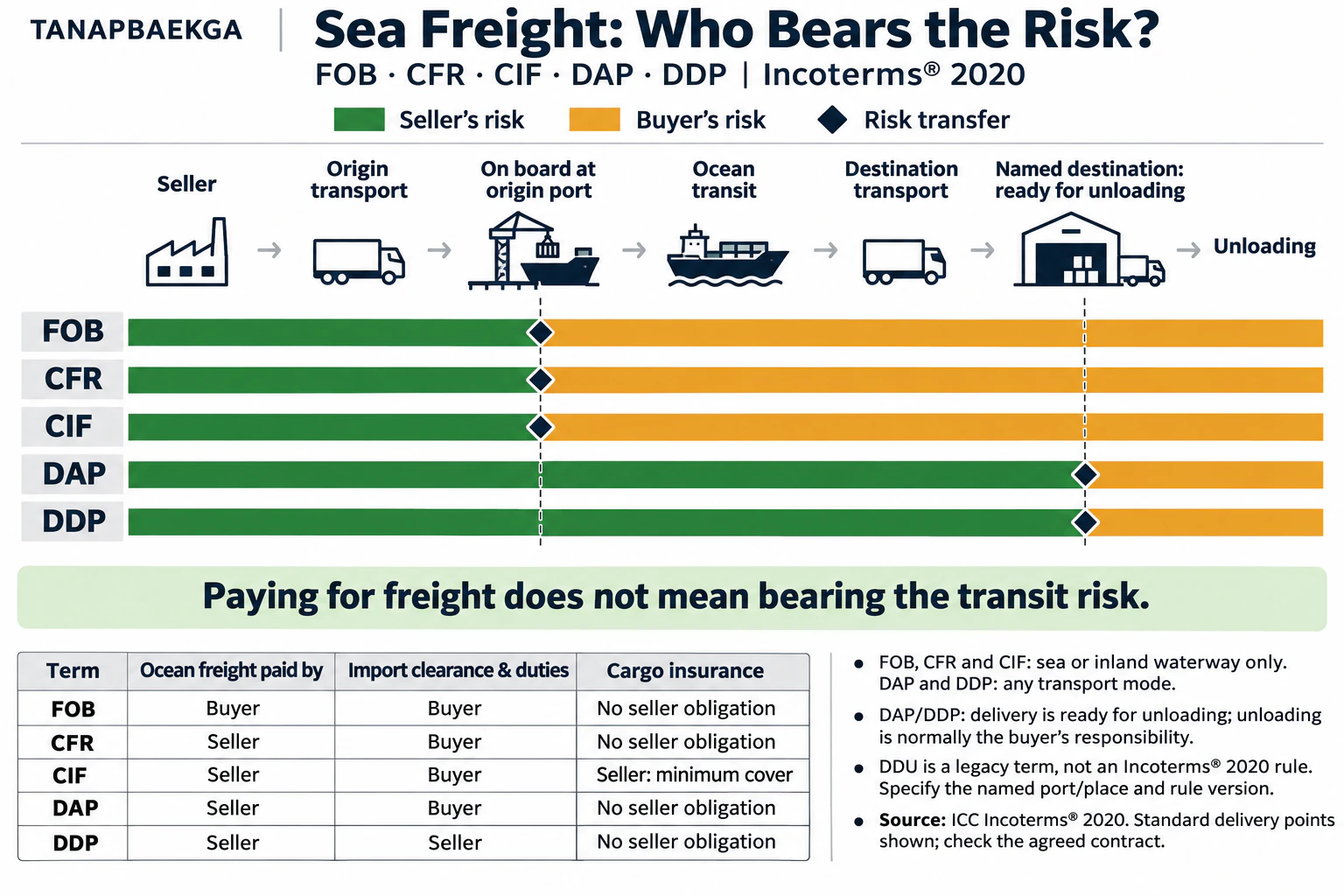
FOB, CFR, and CIF apply to sea and inland waterway transport. For container cargo handed to the carrier before vessel loading, discuss FCA for a buyer-booked shipment, or CPT or CIP if the seller pays for main carriage. For an air shipment, choose a rule suited to air transport. Write the term, named place or port, and rule version in the order. See the ICC Incoterms® 2020 selection guide and the ICC explanation of how DAP replaced earlier terms including DDU.
Step 4. Check Customs Duties and Import Taxes
Before confirming the order, ask your broker to check importer registration, product-specific restrictions, required reports or declarations, and labeling rules for your destination. For products intended for direct food contact, agree on the applicable requirements and evidence before production. Confirm advance filing deadlines before booking or loading; Step 13 covers the final document check.
Send your customs broker the product photo or drawing, material composition, intended use, country of origin, and invoice value. The duty depends on the destination’s tariff classification, customs value, origin, and any additional measures that apply at entry. Preferential rates depend on eligibility, including applicable rules of origin and any supporting documents. A trade agreement alone does not establish the rate for an individual product.
HS code starting point. HS 7323.93 covers certain stainless steel table, kitchen, and household articles and parts. Use it as a classification lead. A wall-mounted fixture, a standalone organizer, and a component for another product can require different classifications. Ask your broker to confirm the full destination code and any additional duties before you order. See the UN classification entry for HS 7323.93.
China Customs Code References for Household Products and Accessories
The table below lists selected Chinese customs codes for household products and accessories. Confirm the classification for your actual product and the full destination-country code with your customs broker.
| Product description | China customs code (10 digits) |
|---|---|
| Stainless steel table, kitchen and household articles and their parts, such as dish racks, fruit baskets, bowls and trays | 7323930000 |
| Spoons, forks, ladles, skimmers and similar kitchen or table utensils, supplied individually and not plated with precious metal | 8215990000 |
| Other non-enamelled iron or steel table, kitchen and household articles and parts (excluding stainless steel and cast iron) | 7323990000 |
| Other iron or steel sanitary ware and parts, including applicable stainless steel sanitary articles | 7324900000 |
| Base-metal hooks, eyes and eyelets for clothing, footwear, bags and similar made-up articles | 8308100000 |
Reference: China’s 2026 import and export tariff schedule. The listed codes cover different materials and uses; select the code that matches the goods being shipped.
Import Duty Lookup by Country
| Country / region | Official tariff lookup |
|---|---|
| United States | hts.usitc.gov ↗ |
| Canada | cbsa-asfc.gc.ca ↗ |
| United Kingdom | gov.uk/trade-tariff ↗ |
| European Union | trade.ec.europa.eu ↗ |
| Australia | abf.gov.au ↗ |
| New Zealand | customs.govt.nz ↗ |
| Japan | customs.go.jp ↗ |
| South Korea | customs.go.kr ↗ |
| India | icegate.gov.in ↗ |
| Singapore | customs.gov.sg ↗ |
| Philippines | finder.tariffcommission.gov.ph ↗ |
| Mexico | snice.gob.mx ↗ |
| Brazil | portalunico.siscomex.gov.br ↗ |
| South Africa | sars.gov.za ↗ |
| United Arab Emirates | icp.gov.ae ↗ |
| Saudi Arabia | zatca.gov.sa ↗ |
| Malaysia | ezhs.customs.gov.my ↗ |
| Vietnam | vietnamtradeportal.gov.vn ↗ |
| Thailand | customs.go.th ↗ |
| Indonesia | insw.go.id ↗ |
How to estimate duty and import VAT or GST
For a percentage-based duty, multiply the customs value by the applicable duty rate. If the destination charges import VAT or GST, multiply the destination’s taxable base by the applicable rate. That base can include customs value, duty, and certain charges. Ask the broker to confirm which freight, insurance, and other costs enter the calculation, and whether any additional duties or fees apply. See the European Commission’s guidance on customs duties and the import VAT taxable amount for an example of how the bases differ.
| Hypothetical duty calculation (USD) | Amount |
|---|---|
| Assumed customs value (goods plus applicable freight and insurance) | $4,200 |
| Customs duty at an assumed 5% | $210 |
| Assumed VAT base ($4,200 + $210) | $4,410 |
| Import VAT at an assumed 10% | $441 |
| Estimated duty plus VAT in this example | $651 |
The rates and bases above are hypothetical. Under DAP, budget for those amounts and import brokerage as the buyer. Under DDP, ask the seller to explain how import duties and taxes are included and who handles the import declaration.
Step 5. Calculate Your Total Landed Cost
Example assumptions. All amounts in the following table are fictional US-dollar budgeting inputs. Replace the product price, freight, duty, tax, and handling figures with written quotations and the destination-specific calculation before deciding on an order.
Use the cost to reach your warehouse as the basis for comparing orders. Start with the supplier’s quoted price and add only the costs outside that quote. Include one-time tooling, testing, or inspection in the purchase decision. For a landed cost per unit, allocate the order-level charges across the units and record how you allocated them.
| Hypothetical budget for 1,200 wire baskets (USD) | Cost |
|---|---|
| Goods at $3.00 each | $3,600 |
| Freight and insurance | $600 |
| Customs duty and import VAT from Step 4 | $651 |
| Separate clearance, handling, and local delivery in this illustration | $250 |
| Total cash outlay to warehouse | $5,101 |
| Approximate cash outlay per basket | $4.25 |
The illustration assumes the $250 is outside the hypothetical tax base. Your broker should confirm the local calculation. If import VAT is recoverable for your business, show it separately when evaluating margin. Compare the final cost with your selling price, channel fees, storage, and any expected returns.
Check carton volume before you commit. For example, 1,200 baskets packed 12 per carton require 100 cartons. At 60 × 40 × 35 cm per carton, the shipment occupies 8.4 m³ before palletization. If the design can nest, confirm that the tighter pack still protects the finish.
Check a packaging change against the whole order
For a hypothetical change from 12 to 10 baskets per carton on the 1,200-piece order, the carton count becomes 120. Measure the revised packed carton before calculating the new CBM. Confirm the change in writing, then update the packing specification, shipping marks, packing list, and forwarder’s cargo data together. Recheck the price and schedule if the change affects materials or handling.
When nesting baskets, trial-pack actual samples with the intended protective layers. Record the outer carton dimensions after closing it, the gross weight, and how products are separated at contact points. TANAPBAEKGA coordinates packaging requirements, samples, and delivery with cooperating packaging suppliers. See our packaging and private-label FAQ.
Step 6. Confirm and Sign the Order
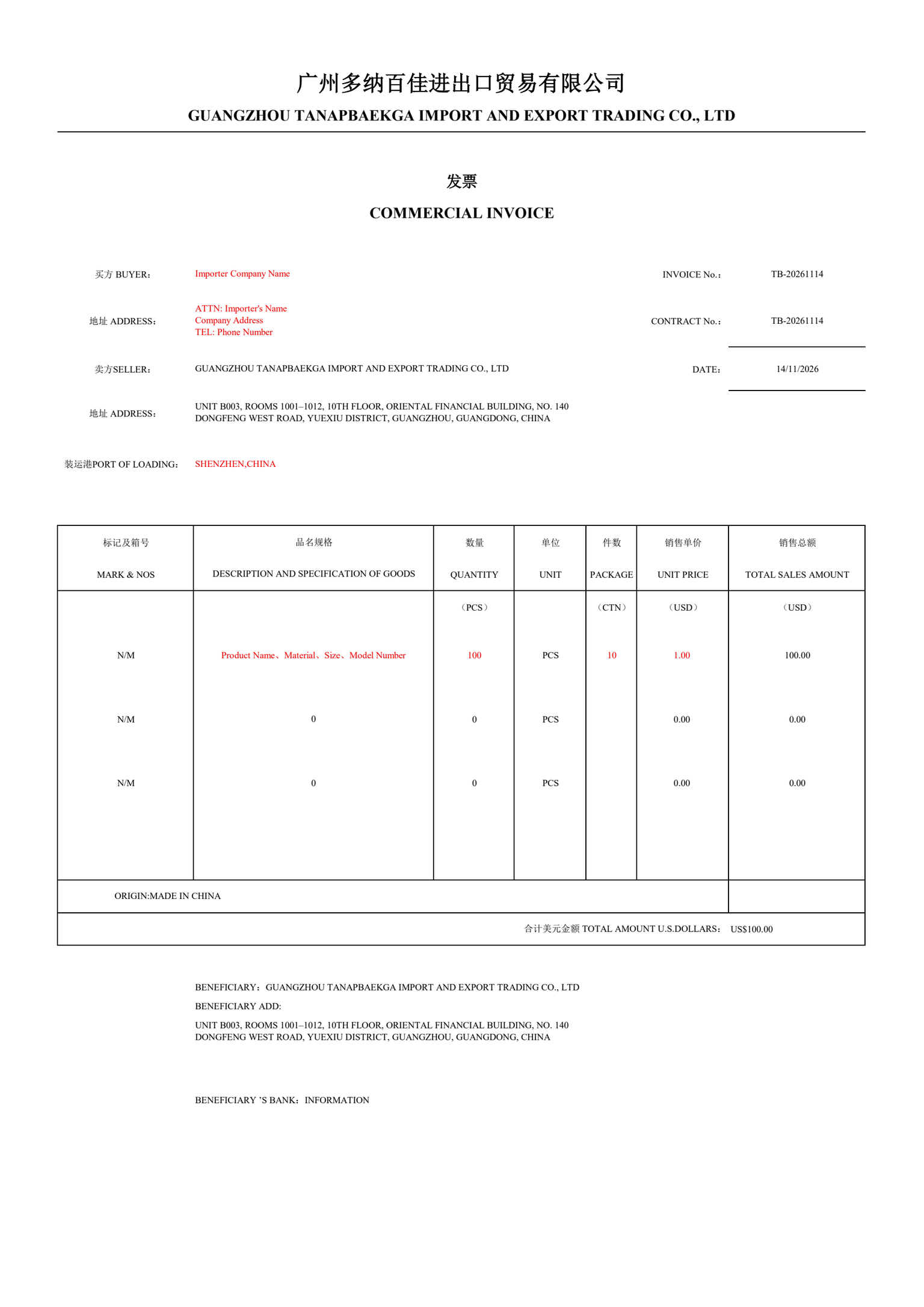
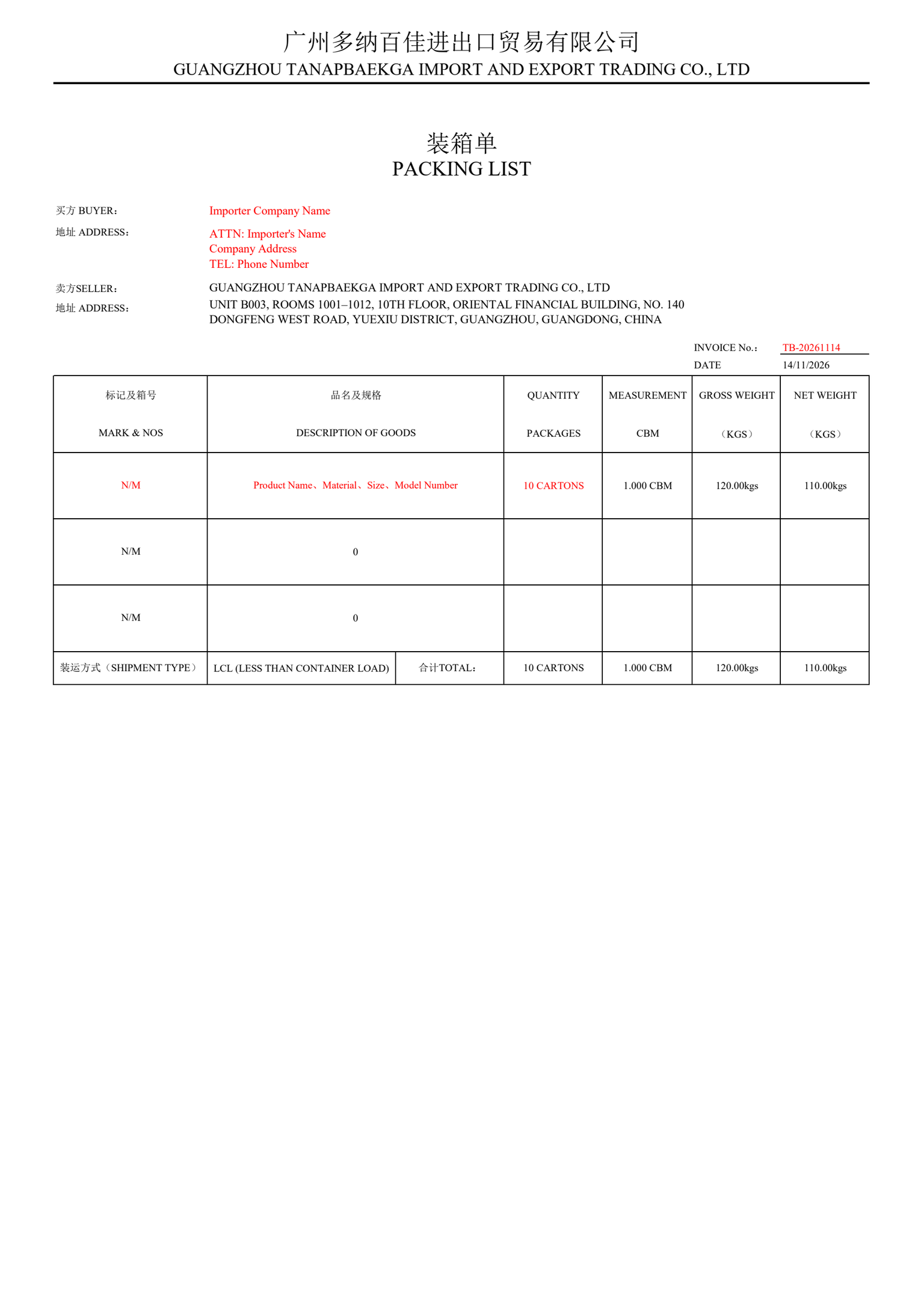
At TANAPBAEKGA, we prepare draft commercial invoice (CI) and purchase order (PO) documents, together with proposed packing details in a packing list (PL), for your review. We fill in the order information and send you the editable Excel files before signing. You or your purchasing team check and approve the details and sign where applicable. These review drafts must be distinguished from the final shipping documents, which are updated to match the actual shipment.
Experienced importers can send their own purchase order and ask the supplier to confirm it and issue a matching commercial invoice. Communicate with the manufacturer and confirm all specifications, quantities, prices, packaging, delivery and payment terms before signing the contract or paying a deposit.
After you confirm the Excel documents, we stamp the agreed documents and send them back to you so you can arrange the deposit according to the agreed payment terms.
| Document | Typical timing and purpose |
|---|---|
| CI (commercial invoice) | TANAPBAEKGA sends a draft Excel invoice for review of descriptions, quantities, prices and totals. The final commercial invoice must reflect the actual transaction and shipment. |
| PO (purchase order) | The manufacturer can prepare the order document for you or your purchasing team to review, approve and sign. Experienced importers can issue their own PO and request the supplier’s confirmation and a matching CI. |
| PL (packing list) | The manufacturer provides proposed packing details for review. Confirm the final carton counts, dimensions, volume, gross weight and net weight against the actual packed goods before shipment. |
| Sales contract | Records the agreed specifications, prices, trade term and named place, delivery requirements and payment terms. Confirm the details before signing; TANAPBAEKGA sends stamped documents after you approve the Excel files. |
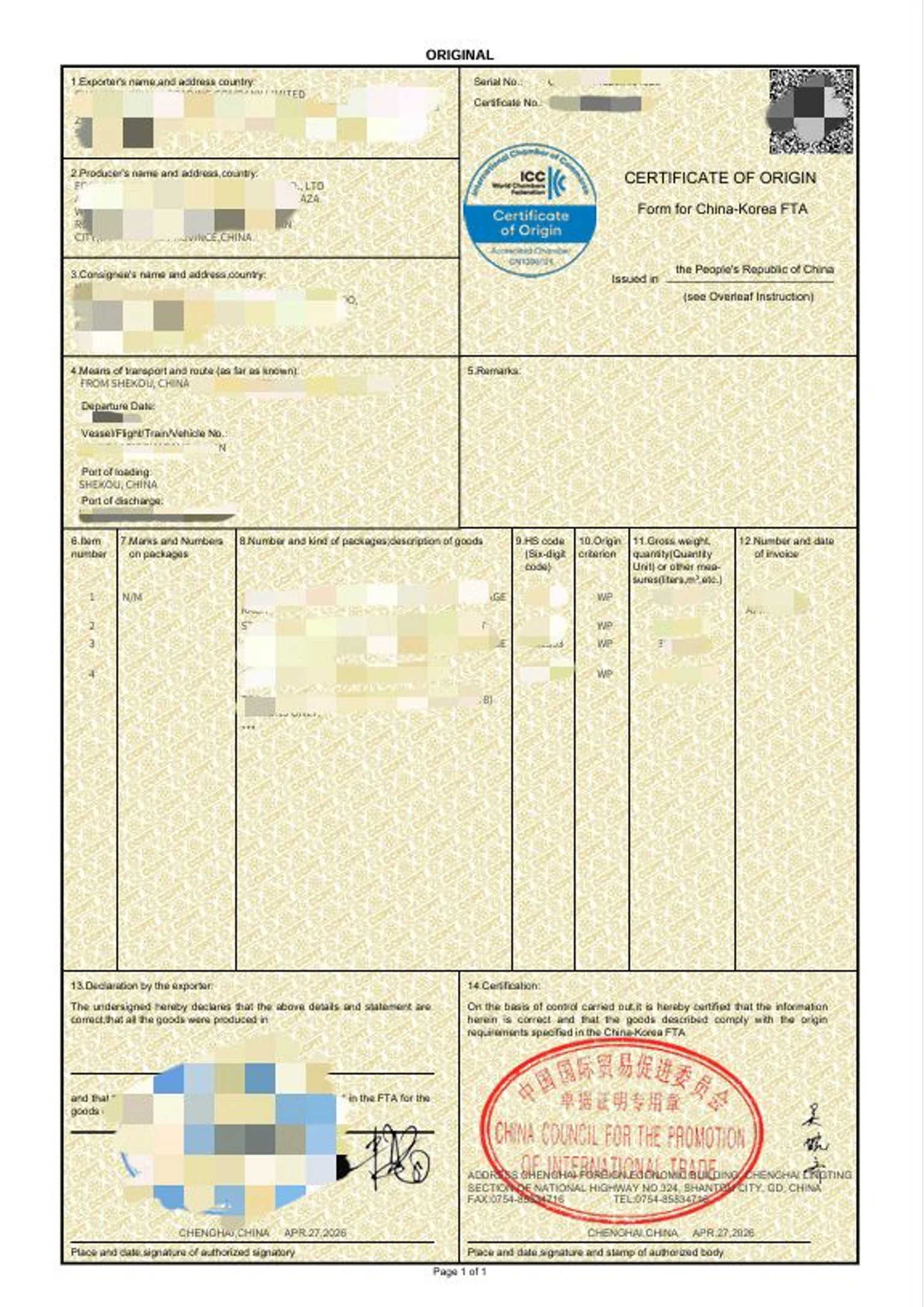
| CO (certificate of origin) | Can support a preferential tariff claim where the goods meet the applicable origin rules. Confirm the certificate type and required supporting information before shipment. |
Document examples. Red text marks fields that need to be completed with your actual order information. Click an image to enlarge.
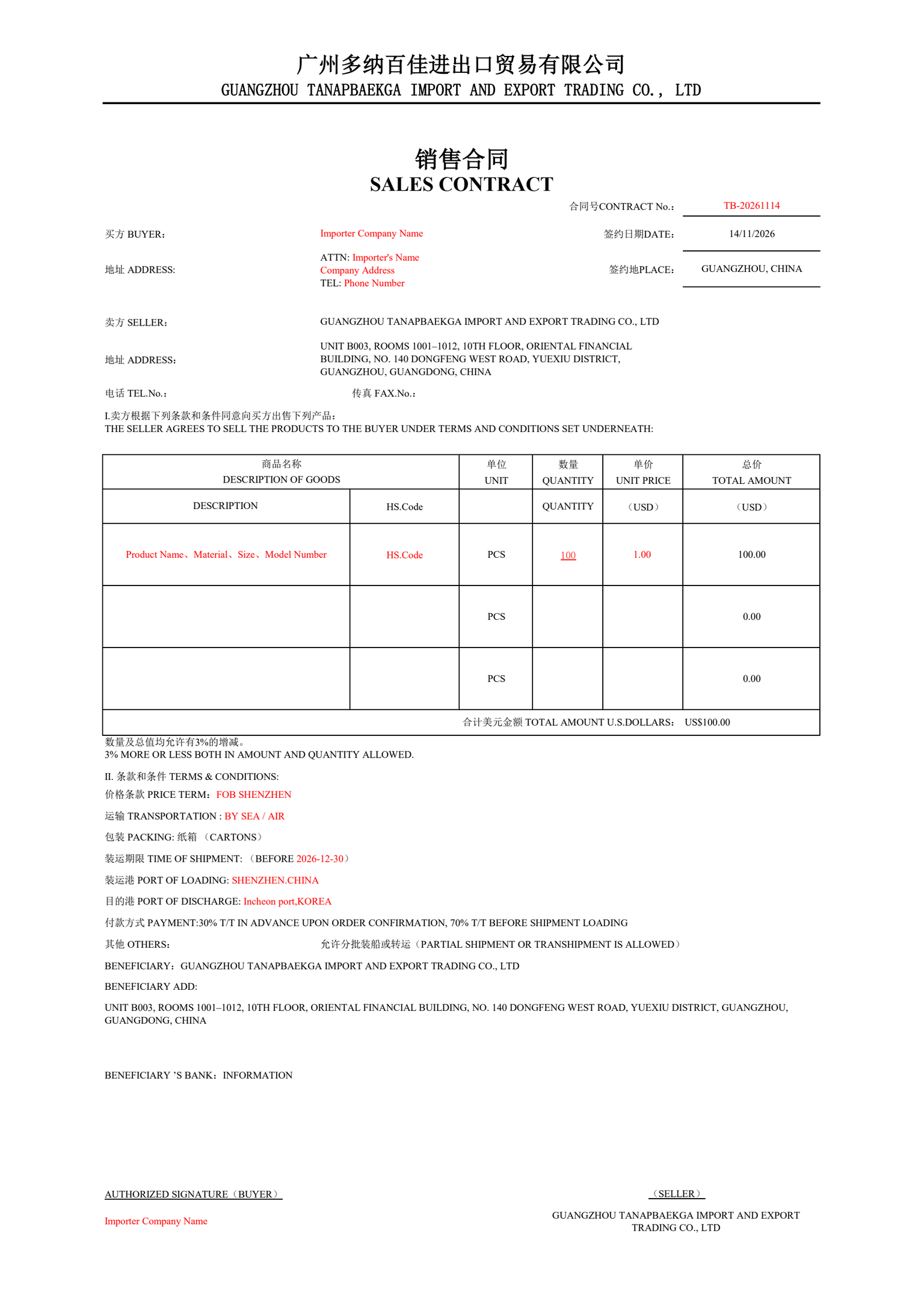
Attach the approved drawing or product reference, pack specification, shipping marks, and label files to the order record. Confirm which document controls if they differ. Check the named contracting party, beneficiary, and payment instructions through a known contact before sending funds.
Where an eligible shipment requires a certificate of origin, confirm the applicable agreement, certificate type and supporting information with us before shipment. TANAPBAEKGA normally applies after the goods have departed from the port, within the issuance deadlines under the relevant agreement. For example, China–Korea FTA certificates are ordinarily issued before, at, or within seven working days after shipment; later issuance is subject to the applicable retrospective-issuance rules. See the published China–Korea FTA origin administration rules.
Step 7. Approve Samples and Start Production
Approve the sample and its drawing revision before the related production starts. Check how plates sit in a dish rack, whether a shower caddy fits the intended mount, or whether nested baskets separate without damaging the finish. Approve retail packaging, carton marks, and barcode placement at the same time if they affect production or packing.
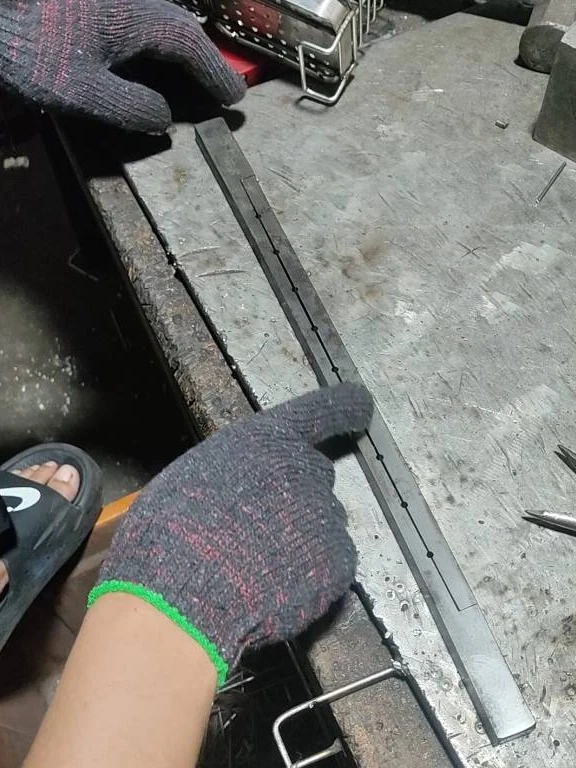
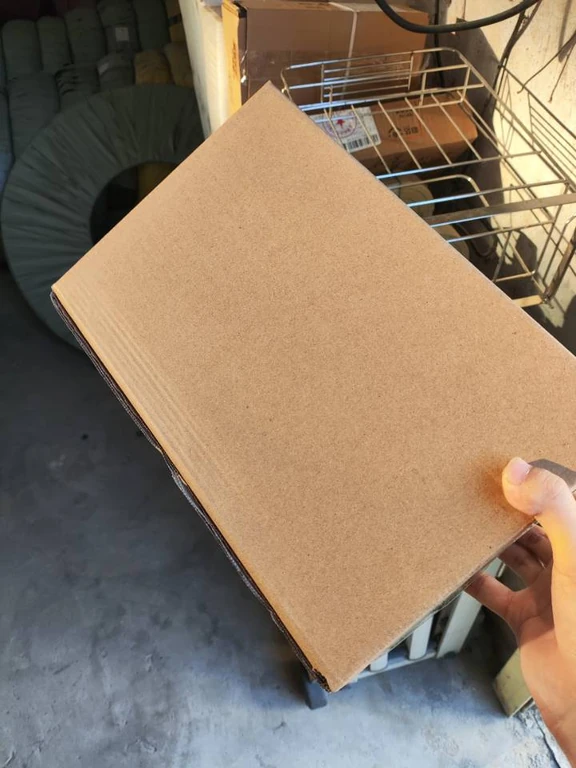
After the agreed approvals and any required deposit, confirm the production schedule. Agree on the quality checks described in Step 8 before the related work starts. Track material preparation, fabrication, finishing, assembly, and packing as applicable. If a change affects the approved design, packaging, cost, or dispatch date, confirm the revised details in writing before the affected work proceeds.
Make sample approval measurable
Keep an approved sample or an agreed photographic reference with the drawing revision and approval date. Record the measurement points and acceptance criteria so the factory and the inspector can repeat the same checks.
| Product feature | What to agree before production | Record to keep |
|---|---|---|
| Rack size and accessory fit | External dimensions, usable opening, mounting centers, tray clearance, and tolerances at the specified points. | Marked drawing and measurement photographs. |
| Stability and load | Test surface, mounting method, load amount and placement, duration, and permitted movement or deformation. | Agreed test instructions and results for the identified sample. |
| Welds, edges, and finish | Acceptable appearance, areas needing smooth edges, and the reference finish for visible surfaces. | Approved close-up photos and written acceptance criteria. |
| Nested packing and labels | Separation at contact points, units per carton, accessory count, barcode file, and label position. | Packing sample photos, approved artwork, carton dimensions, and weight. |
Step 8. Agree on Quality Checks and Inspect the Goods
| Stage | Examples of what to check |
|---|---|
| Before production | Material grade and dimensions on the approved specification, reference finish, inspection method, and any required material records. |
| During production | Wire bends and spacing, weld appearance, critical dimensions, edge condition, and fit of mating parts. |
| Before shipment | Appearance, stability, assembly, accessories, quantity, carton marks, and readable barcode or fulfillment labels. |
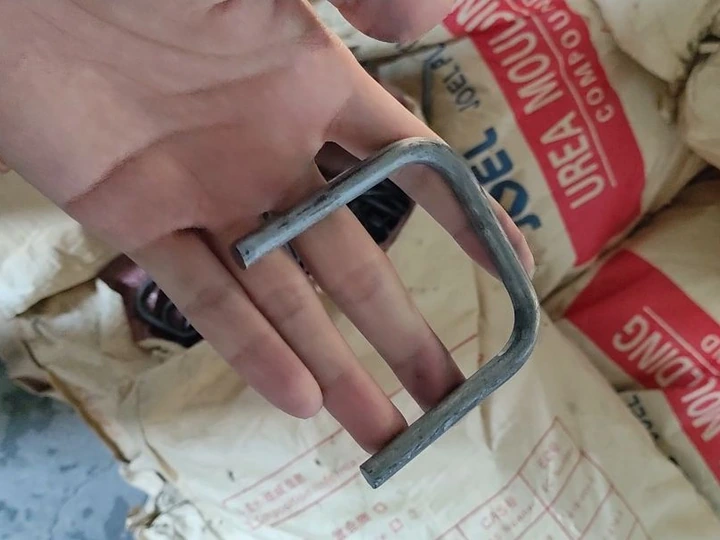
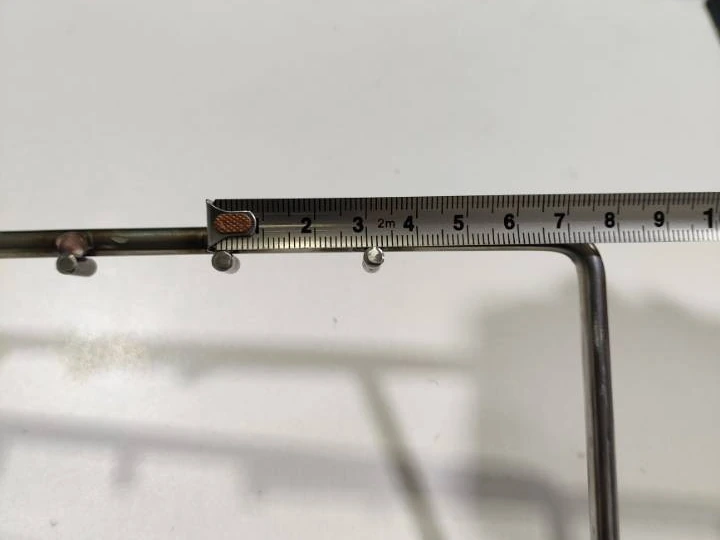
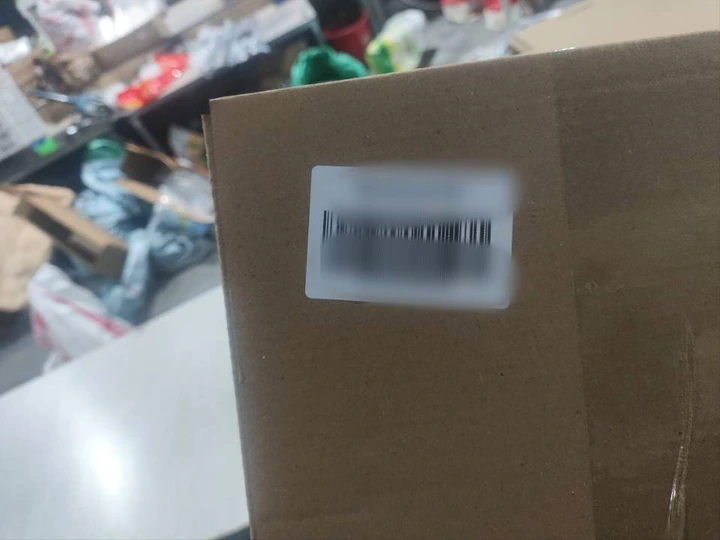
Use the approved sample and drawing as the inspection references. If a load test, corrosion test, or third-party inspection is needed, agree in advance on the method, sample size, acceptance criteria, timing, and who pays. Schedule the inspection before release so there is time to correct a problem or agree on its disposition.
Our routine inspection scope. TANAPBAEKGA’s published workflow checks every unit for appearance, welding, and assembly, with dimensional checks by sampling. Load, salt-spray, and other special tests are agreed separately for the order. Ask which checks your inspection record covers and which units or samples were examined. See our quality-control FAQ.
For an outside inspection, give the inspector the approved drawing, sample reference, SKU list, and packing requirements. Agree the defect categories, sampling plan, and acceptance criteria before the visit. When a problem is found, record the affected quantity, the correction, and any reinspection required before release.
Step 9. Finalize Shipping Arrangements
When the factory confirms the cargo-ready date, update the forwarder with the actual packed CBM, carton count, and weights. Confirm pickup, booking details, cargo cutoffs, routing and the estimated arrival date before committing to a sailing or flight. If your supplier coordinates shipping, request an updated quote showing the origin, freight and destination services included.
Confirm who will submit any destination-specific advance cargo or security filing and when the complete data is due. Provide the broker or forwarder with the draft invoice, packing list and consignee details before the relevant deadline. Some filings are required before loading; do not wait for the goods to arrive.
For LCL, confirm the consolidation warehouse and its cargo receiving cutoff. For FCL, confirm the container size, loading location, and who coordinates the truck and container. For air freight, ask whether pricing uses actual or volumetric weight and whether the quote includes final delivery.
Step 10. Settle the Balance and Agreed Freight Charges
Follow the payment schedule in the signed order. For a balance due before shipment, confirm that the agreed inspection and release conditions are met, and reconcile the final quantity and any approved changes. Confirm which party pays freight, when the forwarder requires payment, and what documentation is needed for cargo or document release.
Step 11. Load and Hand Over the Cargo
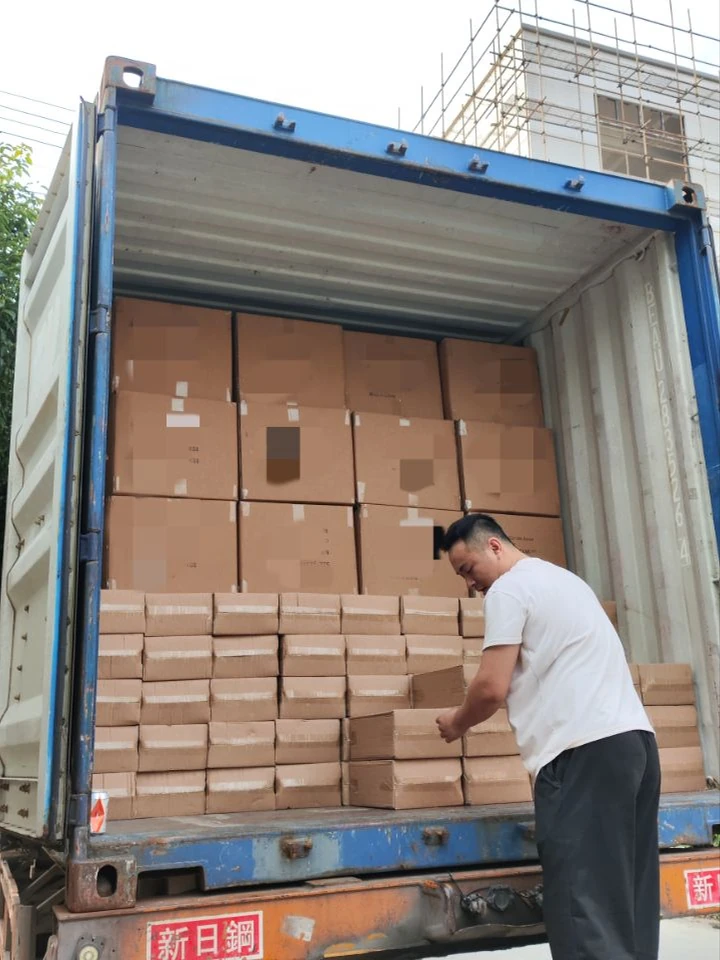
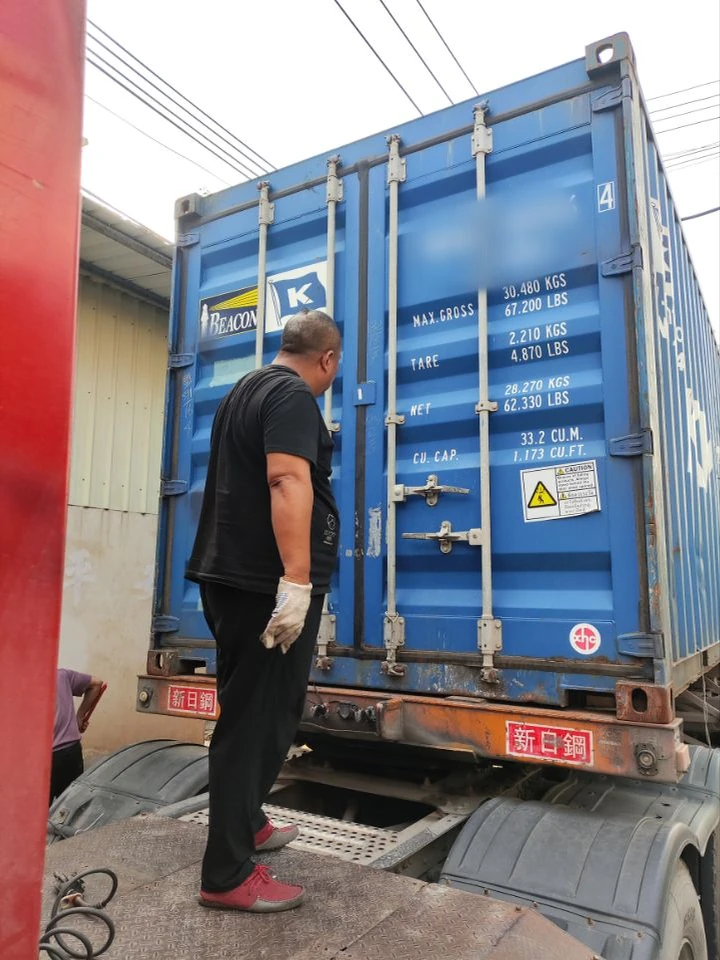
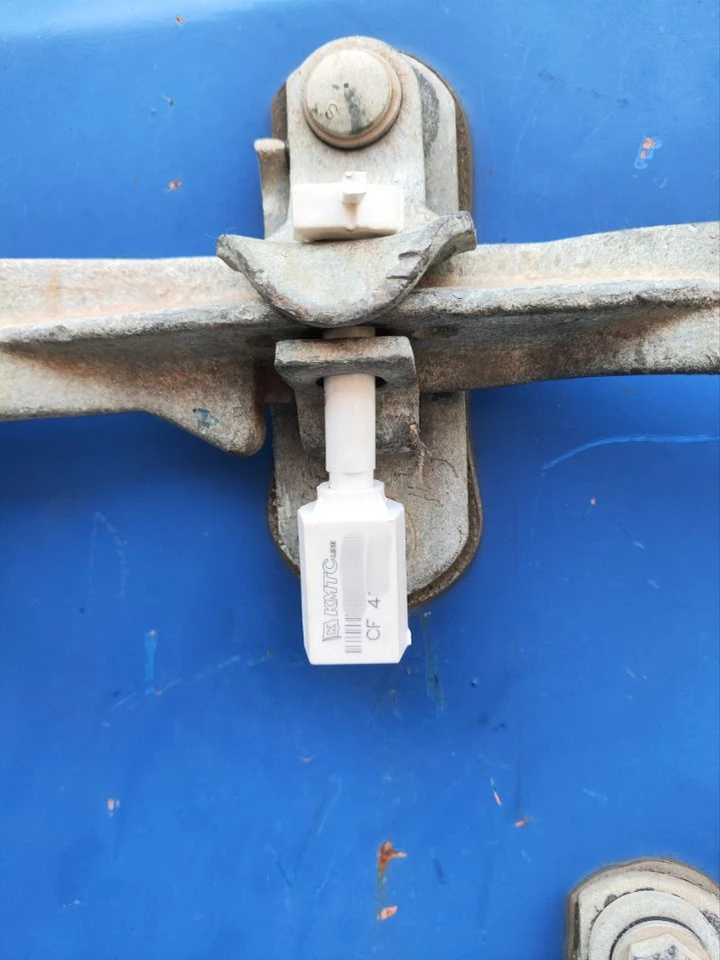
Before loading, match the outer carton labels and count against the packing list. For a full container, check that the container is clean, dry, and suitable for the cargo, and confirm how the cartons will be secured. Where agreed, request loading photos, the container number, and the seal number. For LCL cargo, obtain the warehouse receiving record or handover confirmation from the forwarder.
Step 12. Track the Shipment and Estimated Arrival
Check route and transit estimates during Steps 3 and 9, before booking. After cargo handover, track the actual departure, any transshipment, port arrival and expected warehouse delivery with your forwarder. The published examples below provide planning context for particular services or sailings; they are not current voyage commitments and exclude factory preparation, cargo cutoffs, LCL consolidation, destination clearance and final delivery.
| Destination region | Example route | Published service or sailing example |
|---|---|---|
| East Asia | Shekou, China to Busan, South Korea | 4 days between the listed Shekou call on November 6 and Busan call on November 10, 2026. CMA CGM group line schedule |
| US West Coast | Yantian, China to Los Angeles, United States | 14 days in the January 2025 PRX service profile; historical service example, not a current sailing quote. CMA CGM service profile |
| Northern Europe | Yantian, China to Rotterdam, Netherlands | 41 days on the 2026 Griffin service profile. MSC service profile |
| Oceania | Qingdao, China to Melbourne, Australia | 22 days on the ACX service profile linked as the June 2026 version. |
Track factory dispatch, vessel departure, port arrival, and estimated warehouse delivery as separate dates. Check for transshipment, the latest cutoffs, and any schedule changes before booking. A carrier’s point-to-point schedule tool can help compare departure options.
Step 13. Prepare for Customs Clearance
Complete the final document check with your broker or forwarder before the relevant filing deadline, following the preparations in Steps 4 and 9. Check that the commercial invoice and packing list agree on product descriptions, quantities and package counts, and that the transport document identifies the correct parties and shipment. Resolve discrepancies before cargo or document release; some filings must already be completed before loading.
| Document | When to check it |
|---|---|
| Commercial invoice and packing list | Before dispatch, reconcile the order and the actual shipment with your broker. |
| Bill of lading, sea waybill, or air waybill | Confirm the applicable transport document and cargo release arrangements with the carrier or forwarder. |
| Proof of origin | Check whether the destination or a preferential duty claim requires a particular document or declaration. |
| Product reports, declarations, or permits | Ask your broker which items apply to the exact product and destination. For goods intended for direct food contact, check the intended use and applicable requirements early. |
Confirm who acts as importer of record and who authorizes the broker. Under DAP, the buyer arranges import clearance and pays the applicable duties and taxes. Under DDP, the seller is responsible under the rule. Make sure the actual import arrangement and documents reflect the agreed responsibilities.
Step 14. Receive, Inspect, and Store the Order
Count the cartons at delivery and photograph visible damage before opening them. Compare samples from several cartons with the approved reference. Check model numbers, finish, assembly, accessories, and the labels required by your sales channel. Keep any affected goods and carton labels identifiable while you investigate.
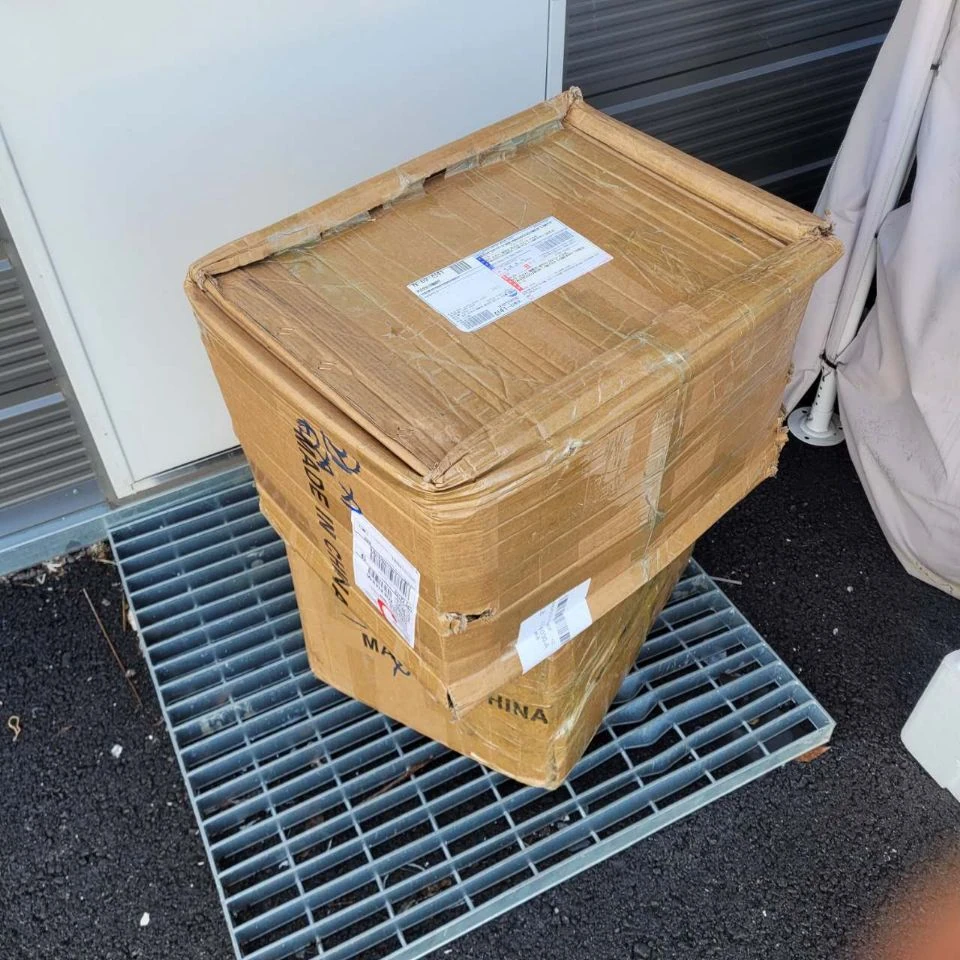
Store accepted stock by SKU and lot or shipment reference in a clean, dry area. If you find a shortage or defect, document the quantity, carton marks, photos, and delivery date, then notify the relevant seller, carrier, or insurer within the agreed reporting window.
Frequently Asked Questions
Can I get a quote without a CAD drawing?
Yes. Send a photo or sketch, the dimensions you know, quantity, and intended use. A detailed drawing becomes more important when the product has tight tolerances, mounting points, or custom accessories.
Can I start with a sample or a small trial order?
Ask about sample availability and the minimum for your specific design, finish, and packaging. When comparing a trial order with a larger order, check how tooling and freight affect the cost per unit at each quantity.
Should a first-time importer choose DAP or DDP?
Ask for both where feasible. DAP lets you work with your own broker and see import charges directly. For DDP, confirm the seller can arrange lawful import clearance, identify the importer of record, and state which charges and delivery services the price covers.
About the Author and This Guide
Zuekiet Wu supports TANAPBAEKGA stainless steel homeware projects, coordinating design, sampling, and production with the company’s factory in Chaozhou. His project focus includes wire baskets, storage racks, and custom metal parts. See the author profile for his work background.
The cost examples are illustrative calculations. Carrier examples describe particular services or sailings. Confirm the current tariff treatment with your customs broker and the actual routing with your forwarder.
For a correction or an order-specific question, email support@tanapbaekga.com with the section name and relevant product or shipment details.
Discuss Your Stainless Steel Homeware Project
Planning an order for dish racks, shower caddies, sink organizers, or wire baskets? Send TANAPBAEKGA a product reference, expected quantity, delivery destination, and packaging requirements. Contact our team for a quotation.